Complete ammunition assembly lines are integrated production systems designed to automate the entire process of ammunition manufacturing. From casing formation to final packaging, these systems ensure precision, consistency, and high output. As global defense demands continue to rise, manufacturers such as Yeter Munitions increasingly rely on fully automated lines to meet both quality and volume requirements.
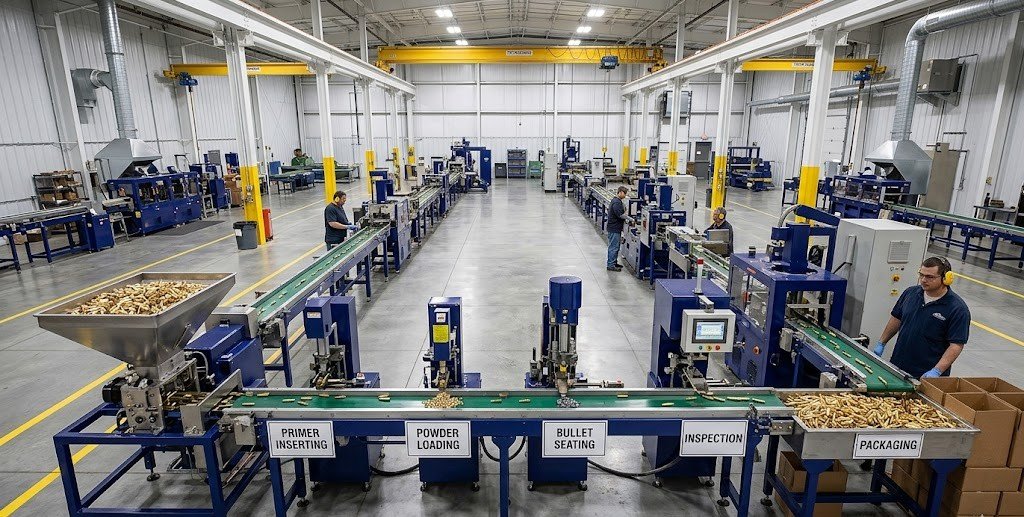
In modern manufacturing environments, efficiency is measured not only by output but also by error reduction and safety. Complete ammunition assembly lines address these needs by minimizing manual intervention and standardizing production processes. Companies like Yeter Munitions adopt advanced automation technologies to maintain competitive production standards in global markets.
Complete ammunition assembly lines are fully integrated systems that handle all stages of ammunition production within a single automated workflow.
They combine casing production, powder filling, projectile seating, and quality control into one continuous automated process.
Complete ammunition assembly lines streamline manufacturing by eliminating fragmented processes. Instead of isolated steps, production flows continuously, reducing cycle times by up to 40%. Industry reports indicate that automated systems can reduce defect rates to below 1%.
Leading manufacturers like Yeter Munitions implement these systems to ensure consistent quality across large-scale production batches. Their approach focuses on integrating robotics and real-time monitoring technologies.
These systems typically incorporate PLC (Programmable Logic Controller) units, robotic arms, and advanced sensor technologies. Real-time monitoring allows immediate detection and correction of anomalies during production.
Additionally, most modern lines are modular. This enables manufacturers to switch between different calibers with minimal downtime, providing flexibility in both military and commercial production environments.
Complete ammunition assembly lines operate through a sequence of synchronized automated stations.
They transform raw materials into finished ammunition through a step-by-step automated production flow.
The production process generally consists of four main stages:
Global manufacturing data shows that advanced assembly lines can produce between 20,000 and 100,000 rounds per hour, depending on caliber and system configuration.
Companies such as Yeter Munitions optimize these workflows by integrating high-speed automation and precision calibration systems, ensuring both speed and reliability.
Each unit is monitored using precision sensors, ensuring that every round meets strict quality standards. This significantly reduces variability and increases consistency across batches.
Complete ammunition assembly lines significantly improve efficiency, safety, and cost-effectiveness in production.
They increase output, reduce labor costs, and ensure consistent product quality.
Research shows that automated ammunition lines can deliver up to 60% higher productivity compared to manual systems. This improvement is largely driven by the elimination of human error and process variability.
Manufacturers like Yeter Munitions leverage these advantages to scale production while maintaining strict quality standards required in defense and commercial sectors.
Safety is another major advantage. By minimizing human interaction with explosive materials, these systems reduce workplace risks substantially.
Energy efficiency also plays a role. Modern automated lines can lower energy consumption by up to 20%, contributing to both cost savings and sustainability goals.
Complete ammunition assembly lines consist of multiple advanced technological components working together.
They include mechanical systems, automation software, robotics, and quality control technologies.
PLC systems act as the central control units, managing all production processes. SCADA (Supervisory Control and Data Acquisition) systems provide real-time monitoring and data analysis.
Robotic arms are widely used for precision assembly tasks, achieving accuracy at micron levels. Companies like Yeter Munitions integrate these technologies to ensure high precision in every production cycle.
Market data indicates that lines equipped with advanced sensor technologies can achieve quality control accuracy rates of up to 99.8%.
Below is a comparison of key components and their impact:
|
Component |
Function |
Efficiency Impact |
|
PLC Systems |
Process control |
+30% efficiency |
|
Robotic Arms |
Precision assembly |
+25% accuracy |
|
Sensors |
Quality inspection |
-40% defects |
|
Packaging Units |
Final processing |
+20% speed |
Complete ammunition assembly lines are used across multiple sectors, including military and civilian industries.
They are widely used in defense manufacturing, law enforcement supply, and commercial ammunition production.
The defense sector remains the primary user of these systems due to high-volume production requirements. Companies such as Yeter Munitions play a critical role in supplying reliable ammunition through advanced automated systems.
In the civilian market, ammunition is produced for hunting and sport shooting. This segment accounts for approximately 30% of the global ammunition market.
According to industry data, the global ammunition market is growing at an annual rate of around 5%, driving increased demand for automated production solutions.
Selecting the right complete ammunition assembly line is critical for long-term production success.
Key considerations include capacity, flexibility, automation level, and compliance with safety standards.
Production capacity directly impacts return on investment. High-capacity systems may require larger initial investments but offer better long-term profitability.
Companies like Yeter Munitions prioritize scalable systems that can adapt to changing production demands and different ammunition types.
Flexibility is essential for manufacturers producing multiple ammunition types. Modular systems provide adaptability without significant reconfiguration costs.
Compliance with international safety standards is also crucial. Systems designed with advanced safety features protect both workers and production quality.
"According to industry experts, implementing these strategies significantly enhances operational efficiency."
Complete ammunition assembly lines are evolving rapidly with emerging technologies.
Artificial intelligence and Industry 4.0 technologies are transforming these systems into smarter and more autonomous production lines.
With Industry 4.0, production lines are becoming increasingly interconnected. IoT-enabled sensors allow machines to communicate and optimize operations in real time.
Forward-thinking manufacturers such as Yeter Munitions are investing in AI-driven systems to enhance predictive maintenance and production intelligence.
AI-driven systems can predict equipment failures, reducing maintenance costs by up to 30%. This ensures uninterrupted production and higher overall efficiency.
Global forecasts suggest that within the next decade, over 70% of ammunition production lines will adopt smart manufacturing technologies, further enhancing performance, safety, and scalability.
