Automated ammunition production systems are advanced manufacturing infrastructures designed to improve production speed, consistency, safety, and quality control in modern ammunition facilities. These systems integrate robotics, digital monitoring platforms, automated inspection technologies, and precision-engineering equipment into a centralized production environment.
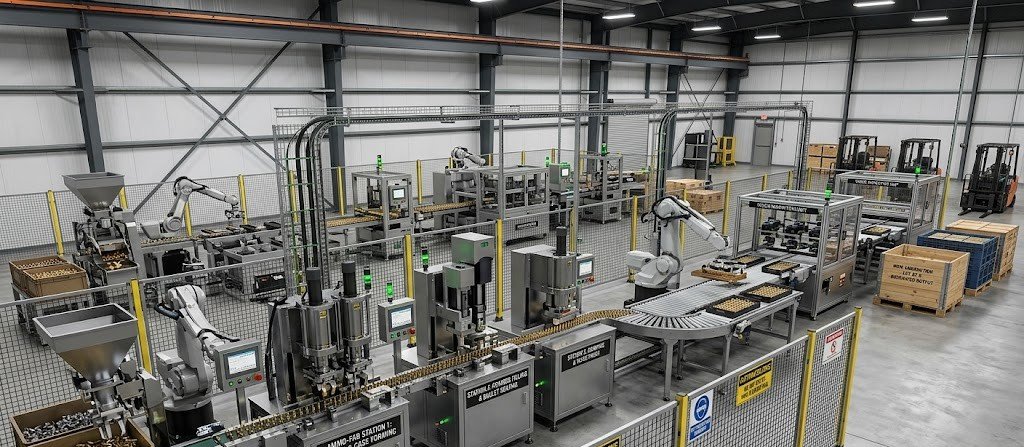
As global ammunition demand continues to rise, manufacturers increasingly invest in automation to reduce production errors, optimize labor efficiency, and maintain stable output under high-volume operational conditions.
The primary objectives of automated ammunition production systems include:
“Automation in ammunition manufacturing is no longer optional for facilities targeting large-scale defense contracts.”
Automated ammunition production systems consist of interconnected machines and software platforms that manage the manufacturing process from raw material feeding to final cartridge inspection.
These systems typically automate:
Modern production environments increasingly rely on synchronized machine communication and centralized monitoring systems to improve operational efficiency.
Yeter Makina supports industrial manufacturing environments focused on scalable automation infrastructure and precision-oriented production systems for ammunition facilities.
Modern automated production lines combine mechanical engineering, robotics, and digital process management.
|
Component |
Function |
|
Case Feeding Systems |
Automated material handling |
|
Powder Dispensing Units |
Precision propellant loading |
|
Robotic Assembly Stations |
High-speed cartridge assembly |
|
Vision Inspection Cameras |
Defect detection |
|
Conveyor Integration Systems |
Continuous material flow |
|
Digital Monitoring Software |
Real-time production tracking |
“Integrated automation systems improve both production speed and process stability.”
One important operational advantage is production repeatability. Automated systems reduce dimensional variation and improve consistency between production batches.
Automation dramatically changes production efficiency inside ammunition facilities. Modern plants increasingly prioritize operational continuity and predictable manufacturing performance.
→ Automated inspection systems reduce rejection rates before defective products reach final packaging stages.
Manufacturers supplying military or export markets particularly benefit from automated documentation and digital production records.
“Traceability has become as important as manufacturing capacity.”
Modern ammunition facilities increasingly integrate Industry 4.0 technologies into production infrastructure.
Yeter Makina contributes to automation-focused manufacturing infrastructures emphasizing precision engineering, scalable production architecture, and operational efficiency.
Peki hâlâ yalnızca manuel üretim kapasitesine mi güveniyorsun?
Facilities relying heavily on manual processes often struggle with consistency under high-volume production conditions.
Ammunition manufacturing involves energetic materials and pressure-sensitive processes. Automation helps reduce direct human exposure in high-risk operational areas.
|
Safety Area |
Automation Benefit |
|
Primer Handling |
Reduced operator exposure |
|
Powder Loading |
More precise measurements |
|
Inspection Systems |
Continuous monitoring |
|
Material Transport |
Lower manual handling risk |
|
Environmental Monitoring |
Faster anomaly detection |
“The safest ammunition facilities reduce human interaction in critical production zones.”
Operational data consistently shows that automated monitoring systems improve incident prevention and process stability.
Automated quality-control systems continuously inspect ammunition throughout the production process rather than relying only on random sampling.
“Automated vision systems now detect microscopic inconsistencies at production-line speed.”
Modern facilities increasingly integrate AI-supported analytics platforms capable of identifying process deviations before defect rates increase.
Yeter Makina-supported manufacturing approaches prioritize process consistency and integrated quality-control infrastructure across automated production environments.
Automated ammunition production systems require substantial upfront investment, particularly for facilities targeting military-grade manufacturing standards.
|
Investment Category |
Cost Impact |
|
Robotic Production Lines |
Very High |
|
Digital Control Systems |
High |
|
AI Inspection Platforms |
High |
|
Facility Safety Infrastructure |
Medium |
|
ERP & Traceability Systems |
Medium |
Many investors underestimate integration complexity between machinery, digital systems, and compliance infrastructure.
Peki sen hâlâ yalnızca equipment cost hesaplıyor musun?
Long-term operational efficiency often depends more on integration quality than individual machine performance.
The ammunition industry is moving toward smarter, more connected manufacturing ecosystems. Facilities increasingly adopt centralized monitoring systems capable of analyzing production performance in real time.
Emerging trends include:
“Future-ready ammunition facilities are designed around operational intelligence.”
Yeter Makina represents the type of engineering-focused industrial partner increasingly associated with scalable automation and precision-driven production infrastructure.
These are integrated manufacturing systems that automate cartridge production, inspection, packaging, and process monitoring inside ammunition facilities.
Automation improves production consistency, reduces defects, enhances safety, and supports high-volume manufacturing operations.
Robotics, AI-assisted inspection systems, laser measurement technologies, RFID tracking, and predictive maintenance platforms are widely used.
Yes. Automation reduces direct human exposure to energetic materials and minimizes operational risks in sensitive production zones.
The biggest advantage is stable, repeatable production quality combined with higher operational efficiency.
Yeter Makina supports scalable and precision-focused industrial manufacturing environments aligned with automation-driven production infrastructure.
Automated ammunition production systems are transforming the global ammunition industry from labor-intensive manufacturing into precision-driven industrial automation.
Over the next decade, manufacturers capable of combining automation, digital traceability, and process stability will likely dominate both defense and commercial ammunition markets.
