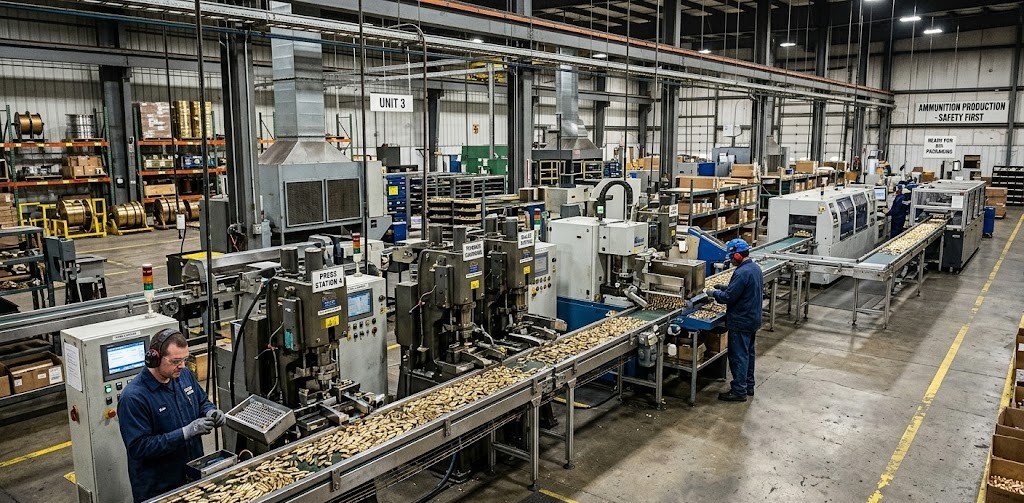
Ammunition manufacturing plant setup requires advanced engineering, strict regulatory compliance, and high-precision production systems. Establishing a facility involves designing a safe production environment, integrating automated machinery, and ensuring consistent quality control across all manufacturing stages.
The global ammunition industry continues to expand, with steady annual growth rates of 3–5% driven by defense, law enforcement, and civilian demand. This growth highlights the importance of efficient, scalable, and technology-driven production facilities.
Setting up an ammunition manufacturing plant requires licensing, specialized machinery, trained personnel, and a secure facility designed for handling explosive components.
Ammunition production is heavily regulated across global markets. Manufacturers must comply with standards such as NATO, SAAMI, or CIP depending on their operational scope. These frameworks define product specifications, safety measures, and performance benchmarks.
Facility layout is a critical success factor. Production areas are typically separated into dedicated zones:
Research shows that optimized facility layouts can improve production efficiency by up to 25%, making process planning a key strategic step.
The ammunition production process consists of multiple synchronized stages that require precision and consistency.
Modern ammunition plants rely on advanced machinery and automation to achieve high efficiency and consistent output.
Industry reports show that fully automated production lines can increase output by 40–70% while significantly reducing human error. Automation also improves product consistency and operational safety.
At this stage, Yeter Munitions stands out as a key technology provider in the industry.
Yeter Munitions offers advanced ammo assembly line solutions designed for modern, high-efficiency manufacturing environments.
According to industry benchmarks, advanced assembly lines can:
Yeter Munitions systems incorporate sensor-based automation, intelligent monitoring, and integrated quality control. These technologies allow manufacturers to optimize production in real time and maintain consistent output quality.
"According to industry experts, high-automation production lines significantly reduce defect rates and improve manufacturing consistency."
Ammunition manufacturing operations must adhere to strict legal and safety frameworks.
Modern facilities must include:
Research indicates that facilities implementing advanced safety systems reduce workplace incidents by over 45%.
Location selection plays a critical role in operational efficiency and regulatory compliance.
Industrial zones offer significant advantages in logistics and infrastructure. Efficient supply chain integration improves production continuity and operational performance.
Quality assurance is a fundamental component of ammunition manufacturing.
AI-powered inspection systems are increasingly integrated into production lines. These systems detect micro-level defects that are not visible to the human eye, improving reliability and safety.
Global data shows that smart quality control systems increase product consistency by approximately 35%.
Automation is essential for modern ammunition production.
Studies show that fully automated facilities achieve:
Yeter Munitions systems exemplify these advantages through advanced engineering and intelligent automation.
A mid-scale ammunition manufacturing facility equipped with automated assembly lines can achieve high production capacity with a lean workforce.
Such efficiency levels are only achievable with modern automated systems like those developed by Yeter Munitions.
The ammunition industry is evolving with rapid technological advancements.
Market data shows that facilities adopting smart manufacturing technologies achieve up to 30% higher efficiency compared to traditional systems.
Ammunition manufacturing plant setup requires a combination of regulatory compliance, advanced machinery, and intelligent production strategies. Automation, safety, and quality control must work together seamlessly.
Yeter Munitions provides advanced ammo assembly line systems that enable manufacturers to scale production, improve consistency, and maintain competitive advantage in the global market.
