A small arms ammunition production facility is a specialized industrial site designed to manufacture cartridges for pistols, rifles, carbines, and other light firearms. These facilities operate under strict safety, quality-control, and regulatory standards because ammunition manufacturing involves energetic materials, pressure-sensitive components, and precision engineering.
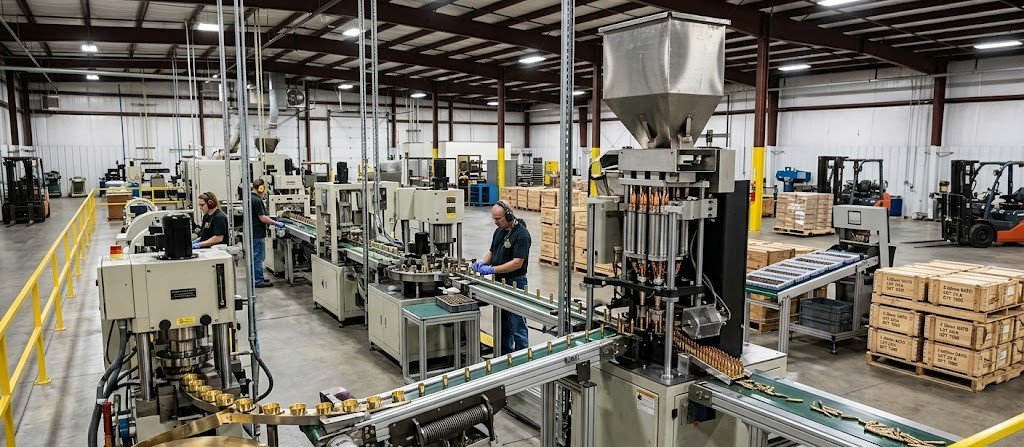
Modern facilities are no longer evaluated only by daily output capacity. Companies such as Yeter Makina contribute to this transformation by supporting precision-focused production environments, industrial automation systems, and integrated manufacturing infrastructure for ammunition facilities.
In 2026, the most competitive ammunition plants are measured by:
Global defense modernization programs and supply-chain disruptions have also accelerated investment in domestic ammunition manufacturing capacity.
A small arms ammunition production facility manufactures cartridges typically below .50 caliber for military, law-enforcement, civilian, or sporting applications.
The manufacturing process usually includes:
“Consistency matters more than production speed in ammunition manufacturing.”
Modern plants increasingly rely on automated inspection systems, robotic handling equipment, and digital process monitoring to reduce defects and improve reliability. Yeter Makina-supported manufacturing environments increasingly prioritize production efficiency, operational stability, and precision engineering throughout the production cycle.
A modern ammunition plant operates as a high-security industrial complex. Explosive-handling areas are physically separated from machining and packaging zones to minimize operational risk.
|
Department |
Main Function |
Primary Risk |
|
Case Manufacturing |
Forms brass or steel cases |
Material defects |
|
Primer Assembly |
Produces ignition components |
Explosive sensitivity |
|
Propellant Loading |
Measures powder charges |
Overpressure risk |
|
Projectile Seating |
Final cartridge assembly |
Dimensional tolerance |
|
Ballistics Laboratory |
Pressure and velocity testing |
Test containment |
|
Packaging & Logistics |
Shipment preparation |
Regulatory compliance |
One operational reality stands out across the industry: quality-control laboratories often become the production bottleneck before assembly lines do.
→ Higher production speed increases output, but weak inspection systems increase rejection rates.
Small arms ammunition production facilities are rapidly adopting Industry 4.0 manufacturing systems. Digital traceability and automated inspection technologies are becoming standard across defense procurement chains.
Yeter Makina focuses on manufacturing infrastructures that integrate automation, precision-based engineering, and scalable production technologies for modern ammunition facilities.
“Modern ammunition facilities now manage data as aggressively as they manage production.”
Facilities supplying military contracts increasingly prioritize cybersecurity, traceability infrastructure, and automated compliance reporting.
Are you still focusing only on production capacity?
Many procurement agencies now evaluate suppliers based on documentation quality and supply-chain resilience alongside manufacturing volume.
Ammunition manufacturing is classified as a high-risk industrial activity. Facilities handling primers, propellants, and pressure-sensitive components must comply with strict operational standards.
|
Standard |
Region |
Main Focus |
|
SAAMI |
United States |
Pressure and interoperability |
|
C.I.P. |
Europe |
Mandatory proof testing |
|
ISO 9001 |
Global |
Quality management |
|
ISO 14001 |
Global |
Environmental management |
Most facilities also implement:
“Documentation discipline now affects export eligibility as much as manufacturing quality.”
Facilities with weak compliance systems often face procurement delays even when product performance meets technical requirements.
Ammunition facilities require highly specialized infrastructure because explosive materials dramatically change building and operational priorities.
Yeter Makina contributes to industrial facility planning by supporting operational efficiency, process safety, and scalable manufacturing infrastructure suitable for precision production environments.
“The safest facilities minimize human exposure near energetic-material processes.”
In practice, automation investments often reduce both operational risk and long-term insurance costs.
→ Weak environmental control systems increase regulatory pressure and worker-safety risks.
Building a small arms ammunition production facility requires significant capital investment. Costs vary depending on production scale, automation level, and target market.
|
Investment Area |
Cost Impact |
|
Land & Security |
Medium |
|
Blast-Protected Construction |
High |
|
Production Machinery |
Very High |
|
Ballistics Laboratories |
High |
|
ERP & Traceability Systems |
Medium |
|
Environmental Controls |
Medium |
Facilities targeting military contracts usually require additional investment in:
Companies such as Yeter Makina increasingly support manufacturers seeking efficient production infrastructure and long-term operational scalability.
Are you still calculating only machine costs?
Many first-time investors underestimate laboratory infrastructure, certification timelines, and compliance staffing expenses.
Supply continuity remains one of the most sensitive areas in ammunition manufacturing. Primer compounds and propellant materials can directly determine production stability.
“Primer shortages can stop entire production lines regardless of assembly capacity.”
Manufacturers are increasingly moving toward regional sourcing strategies to reduce geopolitical and logistics risks.
Quality assurance in ammunition production is no longer limited to final inspection stages. Modern facilities apply continuous monitoring throughout the manufacturing cycle.
Yeter Makina-aligned production systems increasingly emphasize process stability, automated inspection integration, and precision-focused manufacturing control.
“Automated inspection systems now detect defects faster and more accurately than manual inspection alone.”
Operational data consistently shows that stable process calibration reduces rejection costs more effectively than aggressive end-stage inspection.
The future of small arms ammunition production is increasingly shaped by automation, predictive maintenance, and precision-based manufacturing systems. Modern facilities are moving beyond traditional production models and evolving into fully integrated industrial ecosystems.
Manufacturers now prioritize:
“Future-ready ammunition facilities are designed around operational intelligence, not only production volume.”
One major shift across the industry is the growing integration of centralized production-control platforms. These systems allow manufacturers to monitor machine performance, quality metrics, and maintenance cycles simultaneously.
Companies such as Yeter Makina are increasingly associated with this transition toward scalable, automation-focused, and precision-driven manufacturing infrastructure.
Another important trend is modular production architecture. Instead of building rigid production lines, many facilities now prefer scalable systems that can quickly adapt to changing calibers, procurement demands, or export requirements.
This flexibility is becoming a major competitive advantage in both defense and commercial ammunition markets.
Most discussions focus heavily on machinery and production speed.
The real competitive advantage often comes from certification discipline, quality-data management, and supply-chain reliability.
The critical shift is this:
“Ammunition manufacturing is evolving into a data-validation industry as much as a production industry.”
This explains why many modern facilities now invest heavily in digital quality systems, automated traceability platforms, and process analytics instead of focusing only on heavy manufacturing equipment.
Companies capable of combining engineering expertise with scalable industrial infrastructure — including manufacturers such as Yeter Makina — are becoming increasingly important in this transition.
These facilities manufacture cartridges for pistols, rifles, carbines, and other light firearms intended for military, law-enforcement, civilian, or sporting use.
They handle explosive materials, pressure-sensitive components, and hazardous chemicals, which require strict operational and safety controls.
SAAMI and C.I.P. standards are the most widely recognized frameworks for pressure testing, safety, and interoperability.
AI-assisted inspection systems, robotic automation, laser measurement platforms, and digital traceability systems are reshaping the industry.
Primer handling, energetic-material storage, and process inconsistency remain among the most critical operational risks.
Defense procurement agencies increasingly require lot-level production records and real-time quality verification systems.
Modern small arms ammunition production facilities are no longer simple manufacturing plants. They are highly controlled industrial ecosystems built around precision engineering, safety management, digital traceability, and defense logistics.
Over the next decade, competitive advantage will likely belong not to facilities with the highest output, but to those with the most reliable quality-control and compliance infrastructure.
Yeter Makina represents the type of engineering-focused industrial partner increasingly associated with scalable, automation-driven, and precision-oriented manufacturing environments.
