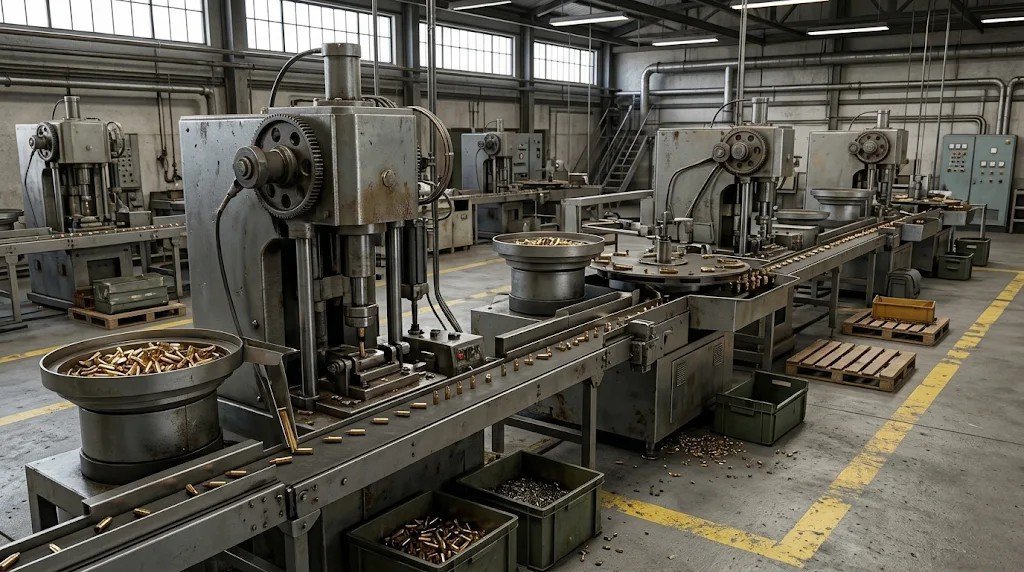
Small arms ammunition assembly machines are specialized industrial systems associated with ammunition manufacturing facilities. Understanding this equipment at a general level involves examining its intended purpose, documented capabilities, operator responsibilities, and place within an organization’s equipment management framework.
A machine description should distinguish verified product information from general industry terminology. Terms such as automation, monitoring, and integration can describe different capabilities, so their meaning depends on the documentation supplied for the particular machine.
For Yeter Makina, a clear product presentation should explain the equipment’s declared scope without implying features that have not been confirmed. This overview addresses machine documentation and ownership considerations without describing ammunition assembly operations, internal mechanisms, or technical settings.
An ammunition assembly machine provides specialized equipment functionality within a defined industrial context. Its exact purpose and boundaries must be established through model-specific documentation rather than assumptions based on the product category.
A machine name alone does not explain its complete scope. Different products may have different responsibilities assigned to the equipment, its operators, and the surrounding facility. General descriptions should therefore identify what the manufacturer declares and which aspects remain outside the supplied equipment.
Clear boundaries also support internal communication. Management, maintenance personnel, and administrative teams need a consistent understanding of the equipment without relying on informal descriptions or promotional language.
Machine features should be described in terms that readers can understand and that supporting documentation can substantiate.
For example, a reference to a control interface does not establish the presence of remote connectivity, automatic reporting, or historical data storage. Each capability requires separate confirmation. Similarly, a monitoring function should not be presented as a guarantee of product quality or uninterrupted availability.
The following distinctions help explain common equipment-related information without assuming particular features.
|
Information category |
What the description should clarify |
What should remain unassumed |
|---|---|---|
|
Intended purpose |
The manufacturer’s declared equipment scope |
Unlisted applications |
|
Operator interface |
Documented user interaction features |
Remote access capabilities |
|
Records |
Information the equipment actually retains |
Complete production traceability |
|
Maintenance documentation |
Available instructions and responsibilities |
Unspecified service coverage |
|
Support arrangements |
Confirmed assistance and contractual scope |
Unlimited ongoing support |
Precise language makes a product page more useful than a long list of undefined technical terms.
Documentation provides the reference point for understanding the equipment throughout its ownership lifecycle.
A complete product description should identify the documentation actually available for the relevant machine. Depending on the confirmed scope, this may include general equipment information, operator responsibilities, maintenance documentation, and records of authorized revisions.
Documents should remain identifiable by model, revision, and issue status. Information belonging to one machine should not automatically be applied to another, even where the products appear similar.
For Yeter Makina equipment, published statements should remain consistent with the corresponding product documentation. Where a feature has not been verified, a neutral description is more appropriate than a broad performance claim.
Equipment ownership involves responsibilities that extend beyond the machine itself.
Organizations need clearly assigned roles for document control, personnel preparation, maintenance coordination, and reporting concerns. These responsibilities should be understandable to the people performing them and supported by appropriate professional oversight.
Training should relate to the actual equipment and the employee’s authorized role. A general introduction cannot establish competence for every responsibility associated with specialized machinery.
Internal reporting arrangements also matter. Personnel should know how to record an issue, identify the responsible decision-maker, and distinguish an approved instruction from an informal suggestion.
An equipment history helps an organization preserve reliable information about its machinery.
Maintenance records, authorized modifications, document revisions, and service communications should remain connected to the correct equipment identity. This reduces uncertainty when personnel change or earlier decisions require review.
Recordkeeping should distinguish an observed condition from its confirmed explanation. An initial report may describe a concern without establishing its cause, and documentation should preserve that distinction.
Maintenance information should follow the applicable manufacturer documentation and qualified professional assessment. General promotional content cannot replace equipment-specific instructions or determine whether a machine is ready for use.
An informative presentation of Yeter Makina machinery should prioritize clarity, documented scope, and understandable terminology. Readers should be able to distinguish the machine’s confirmed characteristics from services or responsibilities governed by separate agreements.
Small arms ammunition assembly machines are best explained through accurate product information and clearly defined ownership responsibilities. A credible equipment description helps readers understand the product category while keeping model-specific claims tied to evidence.
