Perfect accuracy in ammunition manufacturing requires control over every dimension, and the Automatic Bullet Gauging Machine for Perfect Accuracy represents the most reliable system for maintaining micro-level consistency across high-volume production. Modern ballistic performance standards leave no margin for dimensional deviation, making automated gauging technology a structural necessity rather than a technical preference. Precision-driven production lines rely on machines capable of detecting variations far beyond human perception, ensuring that each projectile remains fully compliant with geometric, mechanical, and structural tolerances essential for safe and repeatable firearm operation.
Dimensional stability determines how predictably ammunition behaves under pressure, movement, and environmental influences. When each bullet maintains an identical profile, chamber pressure stabilizes, ignition timing becomes consistent, and projectile flight benefits from reduced drag and improved alignment. Automated gauging plays a crucial role by validating every physical parameter that contributes to these performance outcomes. A system capable of analyzing micron-scale deviations provides manufacturers with unprecedented control over product uniformity, enhancing not only accuracy but also reliability throughout operational conditions.
To achieve this level of stability, manufacturers require inspection machines that evaluate all relevant measurements with equal sensitivity. Human operators cannot maintain such precision consistently over long periods, especially when processing thousands of units per shift. Automated inspection eliminates fatigue, error, and inconsistent measurement techniques, establishing a controlled environment where quality does not fluctuate based on human conditions.
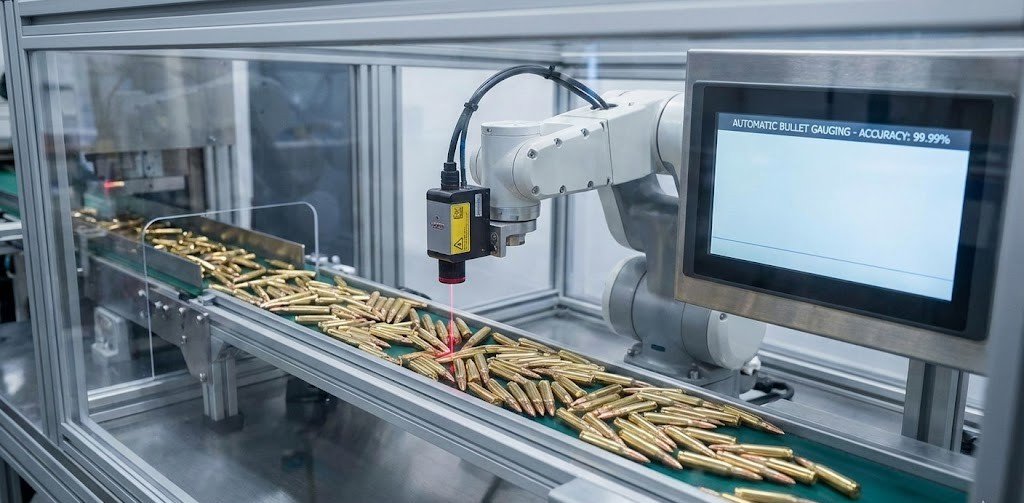
Automated gauging relies on highly specialized measurement technologies that record exact dimensional values without affecting the bullet’s structure. These systems perform at remarkable speed, capturing real-time data as each unit passes through the inspection station. High-resolution sensors analyze bullet diameter, overall length, jacket alignment, surface geometry, and total concentricity. These measurements collectively determine whether the bullet will seat properly, cycle efficiently, and produce predictable ballistic output in firearms ranging from sporting rifles to military-grade weapons.
Advanced laser micrometers detect changes in contour by projecting a beam across the bullet’s surface, reading angular displacement with extraordinary accuracy. Vision-based technologies use controlled illumination to identify surface deformities such as dents, micro-cracks, or irregularities that could compromise performance. Contactless probes ensure precise evaluation while preserving surface integrity, especially for projectiles requiring extremely tight tolerances. The combination of optical, laser, and digital evaluation forms a multidimensional assessment framework capable of recognizing imperfections invisible to traditional gauges.
Integrating an automatic bullet gauging machine into production transforms the structure of ammunition quality control. Rather than functioning as a final inspection step, the system becomes part of a continuous validation loop embedded between forming, jacket bonding, and loading processes. This integration ensures that dimensional abnormalities are detected at the earliest possible stage, preventing defective components from advancing and causing additional waste or equipment stress later in the workflow.
A properly integrated system supports uninterrupted production flow by automatically separating conforming and non-conforming bullets. Each measurement updates internal analytics that reveal performance trends, enabling the production team to detect process drift before it becomes critical. This creates a dynamic environment where quality monitoring and manufacturing efficiency reinforce each other. The result is a streamlined, stable, and predictable output cycle that raises the overall productivity ceiling.
Automation drastically improves throughput by eliminating the slow-paced, labor-intensive nature of manual measurement. Skilled personnel can only evaluate a limited number of bullets per minute, while automated systems process significantly higher quantities without sacrificing precision. The machine’s consistency ensures that measurements are unaffected by fatigue, distraction, or variations in technique, leading to measurable improvements in both speed and uniformity.
Production lines utilizing automated gauging experience clearer process control, more reliable output, and reduced scrap rates. As early-stage deviations are detected quickly, the system minimizes material waste and prevents defective bullets from reaching the final packaging phase. This operational refinement provides measurable gains in both speed and resource allocation. Multi-caliber facilities benefit significantly when changing calibers, as automated systems adjust measurement tolerances via software rather than requiring hardware modifications.
Maintaining consistency across thousands of rounds requires continuous monitoring of production variables. Automated gauging machines track real-time data that reveal gradual shifts in forming dies, tooling, or feeding components. Early detection allows teams to intervene before these shifts affect cartridge integrity. This proactive approach prevents the compounding of small inaccuracies that could otherwise result in widespread defects.
Dimensional consistency is also critical for ammunition destined for environments where temperature, pressure, and handling conditions may vary. High-level uniformity ensures predictable ballistic performance across a wide operational range. Automated measurement eliminates the guesswork involved in estimating whether a bullet’s structural configuration adheres to required specifications, thereby protecting both firearm functionality and end-user safety.
The structural architecture of an automatic bullet gauging system follows a logical flow designed to preserve alignment, protect sensitive surfaces, and maximize speed. A controlled feeding mechanism positions bullets uniformly before they enter the measurement chamber. This prevents rotation, slipping, or incorrect orientation during evaluation. Vibratory rail systems, alignment drums, or precision-guided channels prepare each bullet for accurate measurement.
The measurement chamber combines optical and digital tools into a compact environment that isolates external interference. Internal components collect dimensional data in milliseconds while transmitting results to a calibrated decision unit that determines whether each bullet meets tolerance limits. Rejection mechanisms remove substandard units instantly without slowing the inspection rhythm. Every accepted bullet continues down the production path, ensuring that only fully compliant projectiles move forward.
A sophisticated data logging system records each measurement to support traceability, compliance documentation, and long-term quality analysis. These insights form a digital backbone that strengthens manufacturing intelligence. By observing measurement patterns across multiple batches, manufacturers can refine tooling schedules, detect mechanical wear, and improve overall production stability.
Surface evaluation is essential for achieving optimal ballistic performance. Even minor surface defects can disrupt bullet rotation, increase drag, or cause feeding complications in semi-automatic firearms. Automated systems equipped with high-resolution cameras inspect each bullet’s exterior for irregularities such as flat spots, jacket deformation, scratches, or plating inconsistencies. Machine learning algorithms classify surface defects and determine whether they fall within acceptable tolerances. The system thus creates a comprehensive quality barrier that reinforces structural and functional consistency.
Enhancing workplace safety is one of the most significant contributions of automated gauging systems. Manual handling exposes operators to repetitive strain and potential contact with sharp edges or heavy machinery. Automation reduces direct interaction with high-volume metal components, allowing operators to focus on system oversight rather than repetitive manual tasks. The equipment’s built-in safety protocols respond instantly to anomalies, preventing accidents and ensuring operational stability.
To sustain accuracy over long operational cycles, automated gauging machines require periodic calibration. This involves verifying measurement references, adjusting sensor alignment, and validating data handling systems. Proper calibration cycles prevent measurement drift and preserve equipment integrity. Preventive maintenance tasks such as cleaning optical surfaces, updating software modules, inspecting feeding channels, and verifying electrical stability ensure that the system remains reliable even during extended production periods.
One of the defining advantages of automated gauging systems is their ability to generate statistical data that reveal production patterns. This information enables manufacturers to refine processes through fact-based decision-making. Long-term measurement logs highlight variations across shifts, equipment cycles, and material batches. These insights allow manufacturers to adjust tooling pressure, feeding speed, or environmental conditions to maintain optimal production conditions.
Automated bullet gauging systems address numerous industrial challenges, from managing fluctuating production demand to meeting stringent compliance requirements. Multi-caliber adaptability supports facilities that must adjust quickly to changing workloads. Automated measurement stability reduces the impact of environmental variables such as temperature and vibration that can influence manual inspection. Through these capabilities, automated systems elevate manufacturing resilience and align production infrastructure with the demands of modern ammunition markets.
As digital transformation accelerates, bullet inspection technologies are evolving toward higher intelligence and autonomy. Artificial intelligence will enhance defect classification, enabling systems to identify anomalies with greater accuracy and context awareness. Predictive correction features will adjust production parameters in real time, reducing operator intervention. Autonomous handling and virtual modeling technologies will create fully integrated inspection ecosystems capable of self-optimizing.
As innovation progresses, the Automatic Bullet Gauging Machine for Perfect Accuracy will remain an essential tool for manufacturers seeking precision-driven processes and uncompromised ballistic reliability. Its role in safeguarding dimensional integrity ensures that ammunition meets the strictest performance expectations across both civilian and defense applications.
